- 848.932.7474
- info@rutgersalumni.org
By Richard Stier AG ’74
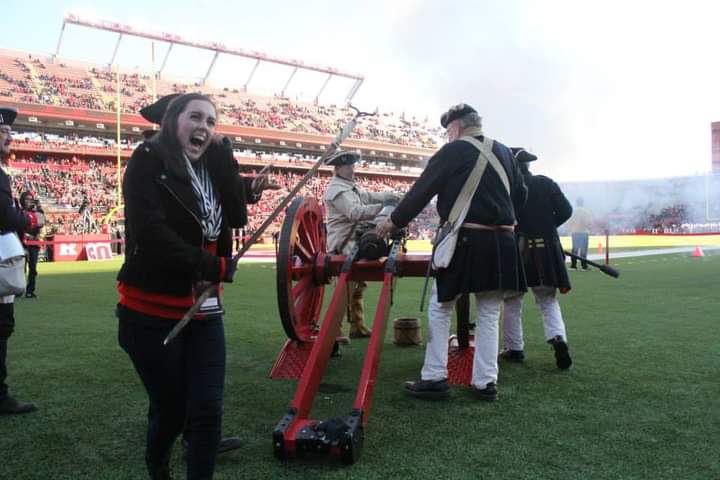
When Rutgers’ football team pours down the chute and onto the field of SHI Stadium, they are greeted with cheers and a booming muzzle-loading cannon. And whenever I hear that cannon roar, I smile to myself, knowing that I played a small role in bringing the gun to Rutgers.
My father, Ted, graduated in 1949 from Rutgers’ School of Education and my mother, Libby, in 1947 from New Jersey College for Women, which later became Douglass College. They started bringing me to games when I was about 3. Back then, Rutgers had a teeny carbide cannon mounted in a red box with wheels that the cheerleaders dragged up and down the sidelines so it would be near Rutgers’ end zone. Yes, it did make a sound, but it somehow seemed inadequate for the birthplace of college football. A game against Army changed that. Let me quote from a letter my dad wrote his classmates on October 25, 1971:
“The cannon really began during the 1967–68 football season and came as a result of seeing the field piece used at West Point (a howitzer). My son, Rick, a member of the Class of 1974 at Rutgers, and I jokingly compared Rutgers’ 10-gauge shotgun with Army’s anti-tank weapon or howitzer. Rick suggested that a revolutionary muzzle loader would be most appropriate. It did seem a rather wild dream. Nevertheless, the class officers and the 20th Reunion Committee bought my suggestion that this be our class gift, which would be a natural since our 20th reunion coincided with the football centennial. (Rutgers and Princeton played the first-ever intercollegiate football game in 1869.)
Everyone present was asked to keep their eyes open and see where a weapon could be found. I ran down several leads, including the U.S. Army and the West Point Museum. Gun dealers, as well as antique collectors, were checked out, but it was not until February 1969, when Fred Hueglin [RC’49] made contact with Mr. W.D. Lentz, owner of the Heavy Carriage Company in Cleveland, Ohio. That got things rolling. Mr. Lentz’s outfit specializes in the building and restoration of full-size cannons for state and federal agencies as well as historical societies and other groups interested in ancient artillery.
The [Reunion] Committee was convinced that this company produced authentic work, and detailed craftsmanship was what we were hoping for. As a result, a formal order was placed in May 1969 with some assurance from Mr. Lentz that our cannon would be available for the centennial season.
On Saturday morning, October 23, 1971, the Class of 1949’s reunion gift rolled into Rutgers Stadium at 10:05 a.m., and shortly thereafter was tested twice before being fired for the first time at the ill-fated Columbia game (a 17–16 loss).
The gun itself is an authentic ¾-scale model of a Revolutionary War field piece. It is slightly over 9 feet long, from the end of the carriage to the tip of the barrel and is nearly 5 feet from wheel hub to wheel hub. The barrel is cast iron and has tubular steel lining. The carriage is made of mahogany and is finished in artillery red (or Rutgers scarlet, if you prefer).
A muzzle-loading piece, it fires a ¼ pound of coarse black blasting powder. Quite naturally, reasonable care must be exercised by the gun crew. The barrel must be doused and swabbed out with water after each shot. Its location at the open end of the stadium seems ideal, and its voice and appearance are everything that we hoped it might be.”
There were a few challenges in having the cannon. One was that there are not many people who understand how to load and fire a cannon that uses black powder. Another issue was that the university did not have a place to store the cannon. The latter question was resolved by my Father, who offered to store it in our garage. So, for many months the cannon slept in the family garage between two cars. This was very convenient since our home was only a mile from Rutgers Stadium. Every game day morning, the gun crew would come by the house, wheel the cannon onto their truck, and secure it for the short ride to the stadium. The gun crew was initially a group from the ROTC. Today, Rutgers uses a team of period re-enactors who know how to load and fire the gun. As a teenager, I thought that it was very cool having the cannon in our garage, so even though I was now living at my fraternity house on Union Street, it was fun to take people home to show off.
When the cannon was presented to the university, the stadium had yet to be expanded, so the cannon was mounted on the hilltop at the south end of the stadium next to the scoreboard. Upon firing, the gun sent a very satisfying cloud of smoke across the stadium, especially when the crew decided to double-shot the gun.
When the cannon made its debut, the Class of 1949 asked if they could select the person to fire the first shot in public. The university agreed and I can proudly say that I was the person who fired that first shot. That’s why I smile to myself each time the cannon roars out a greeting to the football team.
The cannon is now part of my family history. My nephew, Edward Whitehead RC ’11 was allowed to fire the piece when he was about 10 and my niece, Charlotte Whitehead SAS ’71 (below, left) also had her chance to welcome the team in 2014 as a sophomore On the Banks. Very apropos as that was year my Dad passed, so I know he smiled at Charlotte and the cannon as he looked down from above.