- 848.932.7474
- info@rutgersalumni.org
By Marty Siederer LC‘77
For generations of Scarlet Knights, some of the most enduring memories of their time at Rutgers were not made in classrooms, dorms or lecture halls, but over a meal.
Rutgers’ dining halls have been gathering places, social centers, workplaces, stages for student activism and the setting for stories alumni remember decades later. As Rutgers transformed from a relatively small college into a university with campuses in New Brunswick and Piscataway, its dining facilities evolved right along with it. Today’s dining halls – with made-to-order stations, international cuisines, vegetarian and vegan choices, meal swipes and mobile-friendly options – would be unrecognizable to a Rutgers student of the mid-20th century. Today, over 700 staff at 40 locations throughout Rutgers campus throughout the state of New Jersey prepare and serve 30,000 meals each day. Fun Fact: According to Nick Emanuel, executive director of Dining Services, Rutgers makes over 200 dozen New York style water bagels each night. “I used to own a bagel store and wanted to improve the bagels served at Rutgers, so we purchased the equipment and trained our bakers how to make them.”
The Early Years
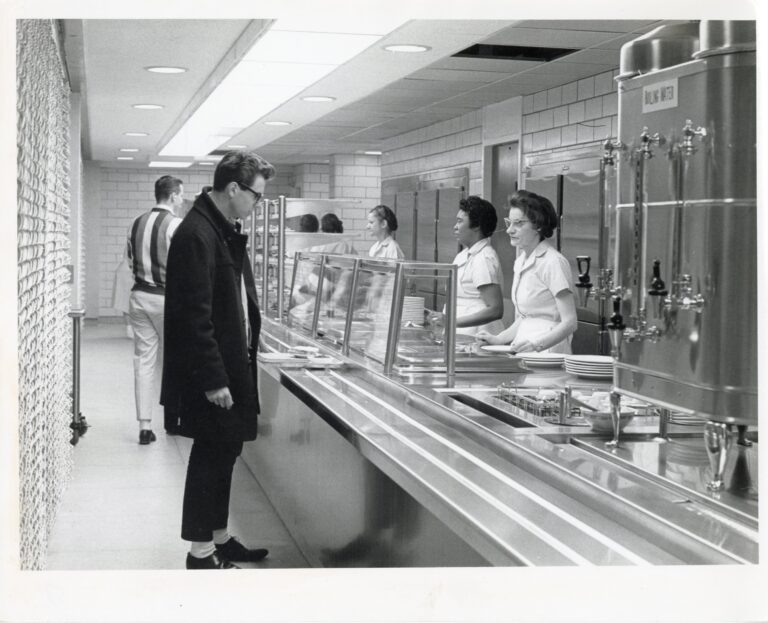
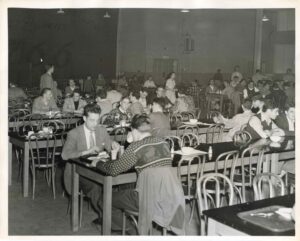
Ballentine Hall at Douglass College, Winants Hall on the Old Queens campus, and the forerunner to Records Hall on the College Avenue Campus served as the earliest dining options for New Brunswick students, with formal attire the norm. As enrollment at Rutgers expanded following World War II, the university needed new facilities to accommodate a rapidly growing student population. By the middle of the 20th century, food service had become an important part of campus life. In 1964, The College Avenue Campus eventually became home to one of Rutgers’ most recognizable dining landmarks: Brower Commons.
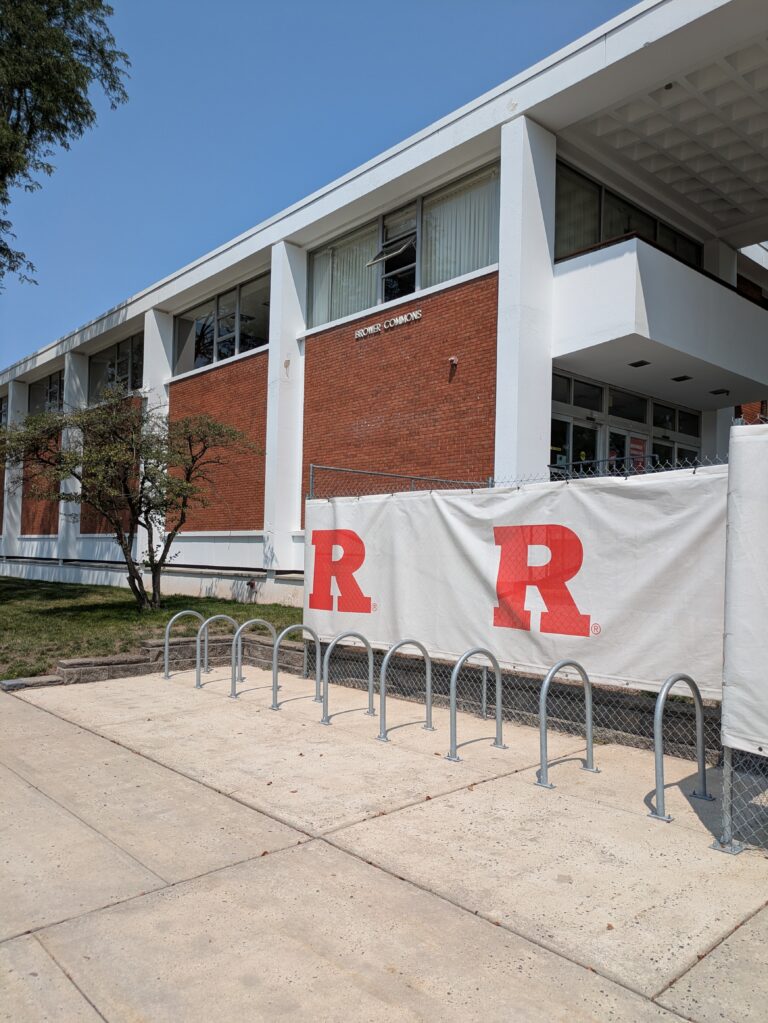
Named for Rutgers alumnus and benefactor Charles H. Brower RC ‘25, Brower Commons became a fixture of College Avenue for more than six decades. Its location made it particularly central to undergraduate life. Students living in residence halls, attending classes nearby or simply crossing campus gathered there for meals. At its peak, 7,000 meals were served each day at Brower.
Brower and Ballentine were not just cafeterias. They were meeting places where friendships were formed, organizations recruited members, dates began, roommates caught up and generations of students developed strong opinions about what was on the menu. The College Avenue dining scene also became intertwined with Rutgers’ history of student activism. Oral histories from alumni who attended Rutgers in the 1960s recall demonstrations and political discussions taking place outside Brower during the turbulent years of the Vietnam War.
On the Douglass campus, Ballentine Hall eventually gave way to the Cooper and Neilson dining halls. The development of the Busch Campus and Livingston College created new challenges: How do you feed a university whose students are increasingly spread across multiple campuses? Dining facilities became essential components of campus planning. They were located near residence halls and student centers, helping turn individual buildings into communities.
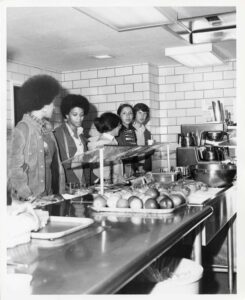
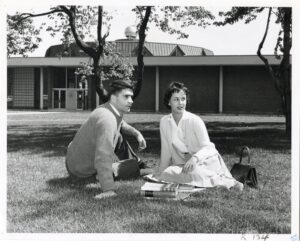
By the beginning of the 21st century, Rutgers Dining Services operated six student dining facilities: Brower Commons, Busch and Davidson on Busch, Cooper and Neilson on Cook/Douglass, and Tillett on Livingston.
The opening of Busch Dining Hall in 1989 was an important milestone. Busch became an important testing ground for changes in the way Rutgers approached food service. In the years that followed, dining hall renovations emphasized more food prepared on site, improved presentation, takeout choices and greater variety. A University report noted that the changes were based on student feedback and were intended to serve as a model for future dining facilities. That philosophy helped usher Rutgers dining into a new era: instead of simply providing a predictable cafeteria menu, dining halls increasingly sought to offer choices that reflected students’ changing tastes.
As Rutgers became increasingly diverse, so did its dining halls. Students asked for more than the traditional meat-and-potatoes cafeteria fare. Rutgers responded with expanded vegetarian selections, Asian-inspired dishes, kosher meal plans and other specialized options. Meal plans changed, too. Rather than being restricted to a set breakfast, lunch and dinner structure, Rutgers moved toward block plans that gave students greater flexibility in deciding when and where to use their meals. The dining halls became a reflection of the university itself: more international, more flexible and more attentive to individual preferences. Meal cards that were punched for each meal and expired at the end of a week or month were replaced by meal swipes and more flexible dining plans.
The Livingston Campus provides perhaps the clearest example of how Rutgers dining has evolved. For years, Tillett served as Livingston’s primary dining facility. But as the campus underwent a major transformation, Rutgers replaced the aging facility with a new, multistory dining complex. The $30.5 million Livingston Dining Commons opened in 2011, replacing Tillett and providing what the university described as a modern dining environment. The new facility was part of a much larger redevelopment of Livingston that included an expanded student center and new student housing. Henry’s Diner, a 1950’s-themed diner, opened on the Livingston Campus in 2013. Prior to coming to Rutgers Nick EmanueI also worked in the diner business and in 2012 was asked by then-executive director of Dining Services Joe Charette to open a “Jersey Diner” on campus which became Henry’s Diner. “Traditionally Dining Services operated all-you-can-eat dining halls so this was a major change in the business model and a challenge finding and training staff, especially short order cooks,” said Emanuel, who brought on current Dining Services assistant director Sebastian Nieto to run Henry’s. “Together we wrote the menu, developed the recipes, selected the china, glass and silverware that the students enjoy today,” according to Emanuel
The Livingston Campus also became home to the Rutgers Club. The club, founded in 1957, had originally occupied a historic house on College Avenue before moving to its current location above the dining commons in 2017.
Like its counterparts elsewhere on campus, Neilson has evolved with Rutgers. The dining hall has become part of a broader food-service network that includes cafés, retail locations and specialty operations throughout Cook/Douglass.
As demand for take-out options grew, Dining Services provided more locations and food choices. Rutgers has also embraced the idea of the dining hall as a living laboratory. Since 2017, Rutgers–New Brunswick has participated in the Menus of Change University Research Collaborative, an international program that uses university dining halls as settings for research into food, health, sustainability and student behavior. An example of this Rutgers initiative is the Harvest Cafe on the Cook campus. The cafe is described as a “globally inspired, planet-friendly cultural hub that brings people together through food and serves as a living laboratory for sustainable food systems.”
Why did all of these changes take place? According to Joe Charette, former executive director of Dining Services, students “voted with their feet. Students’ habits changed, from the types of food they preferred to grab-and-go options, with time over breakfast, lunch or dinner spent not at group tables but catching up on texts or class assignments. We also sought input through town hall meetings, feedback from students and parents, and conversations with other colleges throughout the country.”
The End of an Era on College Avenue
Perhaps no recent development better illustrates the changing face of Rutgers dining than the closing of Brower Commons.
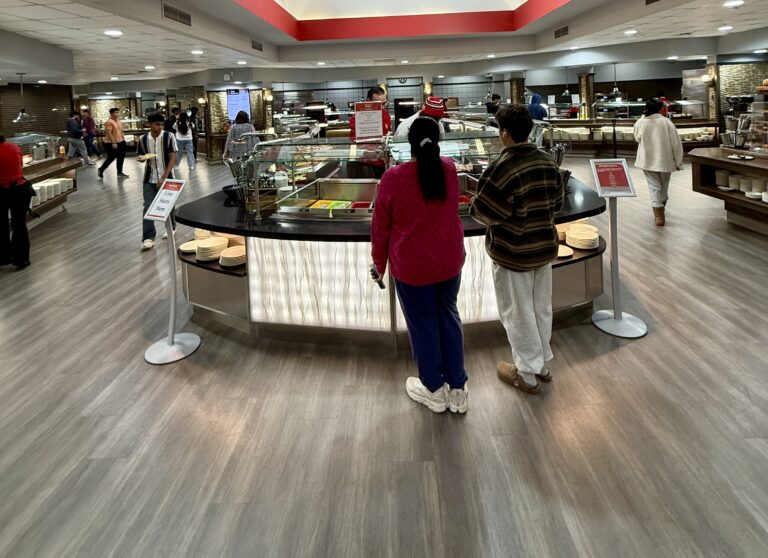
After more than 60 years of service, Brower was replaced in 2023 by The Atrium, a modern food-service destination inside the College Avenue Student Center. The Atrium represents a significant shift from the traditional all-you-can-eat dining hall. Its food-court offers pizza and pasta, Mediterranean, Asian, Southwestern and burger/sandwich selections, while still allowing students to use meal swipes. Mobile food trucks throughout the New Brunswick campus augment the offerings at The Atrium and dining halls.
For alumni who remember Brower, the change can be bittersweet. The building may be gone, but its role in Rutgers history remains. Brower was where generations of Scarlet Knights ate breakfast before class, grabbed lunch between lectures and lingered over dinner with friends. It was a place where students from different backgrounds and academic disciplines crossed paths. And, as Rutgers oral histories demonstrate, it was sometimes a place where the larger events of the day—politics, war, social change and campus life—played out in full view.
Barbara Pollison-Beck DC ‘82 remembered “going to Brower when it opened for lunch, getting a large round table in the middle and staying until closing time. We got to study and eat/socialize with my friends who came in. One day, I asked a few of the men’s basketball team members to join us. We had a crush on a few of the players.” Pollison-Beck’s favorite dining hall was Cooper on the Douglass campus. “We would designate one person to get breakfast on the weekends, give them our meal cards, and they brought breakfast back to the dorm.
For Steven Miller RC ‘76 and current director of undergraduate studies for the School of Communication’s Journalism and Media Studies program, the two meals he always looked forward to at Brower were the Thanksgiving turkey night and the pre-winter break rib roast. “The lines would stream up the long ramps and reach out the door because my fellow students and I saw these dinners as a break from the usual fare doled onto our plates in assembly-line fashion. These were the only times when you could watch a ‘chef’ carve the fresh, steaming meat right in front of you. I tell my current students about these ‘special occasions’ and they laugh because they have so many options at the Livingston and Busch dining halls like wok, deli and vegan stations.”
Emily Casey RC ‘01 recalled grabbing a Daily Targum to read at lunch and scanning the room to find a table with friends, along with special events like the Mexican Cantina Lunch and King Neptune Night, a highly-anticipated seafood buffet. “They had games during King Neptune Night. One time, I won a gold fish. He lived in my dorm with me for the next three years. If we were feeling fancy, we would get a group together and go to The Rutgers Club.”
Rutgers Club Celebrates 70th Anniversary
Founded in 1957 and originally located in a home on College Avenue, The Rutgers Club was established to “provide physical facilities for the alumni and faculty of Rutgers University for professional, social, cultural, and business meetings, to provide dining and other facilities which will promote and perpetuate amity and understanding among the members of the Rutgers family and the best interests of the University.” The club served as a faculty dining facility, along with an area designated for faculty at Brower Commons. Over time, The Rutgers Club invited alumni to become members and held widely-attended events such as annual concerts with jazz guitarist Bucky Pizzarelli, and Christmas and St. Patrick Day parties. Over time, the College Avenue location became fiscally unsustainable to maintain and was slated for demolition as part of a long-term facilities overhaul. The club moved to the Livingston Campus in September 2017, and has expanded its operations to accommodate more culinary events. For more information about The Rutgers Club, visit https://rutgersclub.rutgers.edu/.