- 848.932.7474
- info@rutgersalumni.org

by Marty Siederer LC ‘77

When Rutgers sport fans think of the locations where the Scarlet Knights practice, the fields, buildings and arenas on the Busch and Livingston campuses come to mind, along with the Barn (College Avenue Gym) and behind it, the location where the first college football game took place in 1869. Rutgers fans driving up Route 18 north towards the New Brunswick campus pass by another venue that is rarely mentioned: The Class of 1914 Boathouse, where the men’s rowing team trains. The 2025 team joined the ranks of Rutgers teams that have gone on to compete in national tournaments, finishing 5th at the American College Rowing Association (ACRA) National Championships held in May on Melton Lake in Oak Ridge, Tennessee.
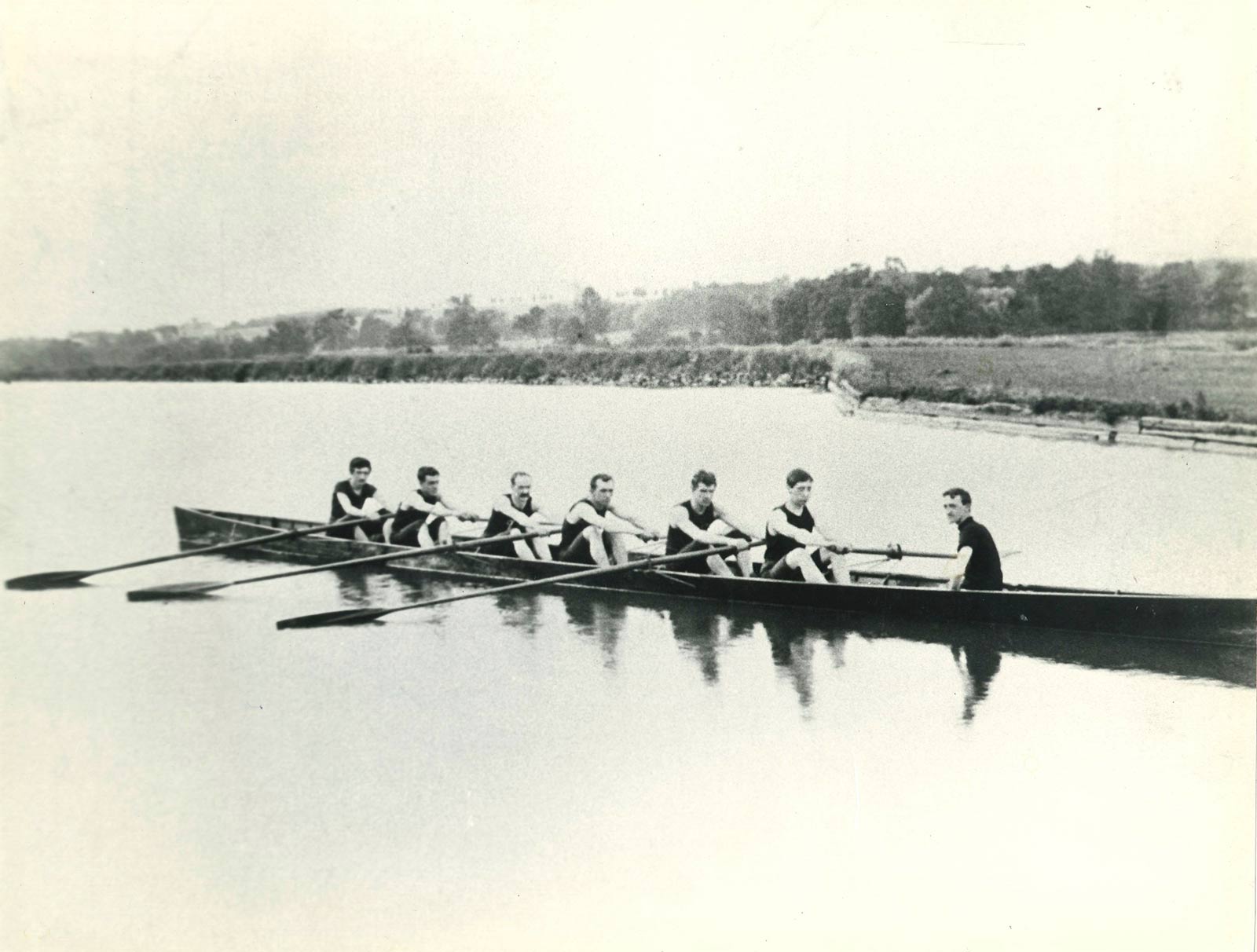
Men’s rowing has an even longer history than the football team. In 1864, rowing became the first organized sport at Rutgers. Six mile races were held on the Raritan River among six-oared boats. In 1870, Rutgers held its first intercollegiate competition, against the Lawrence Scientific School of Harvard, the then top-ranked amateur crew of the time. In 1876, a new floating boathouse was built for the team adjacent the Albany Street Bridge in New Brunswick, but was washed away during a flood in 1898.
The Class of 1914 Boathouse was built in 1950 and is located near the New Brunswick campus on the Raritan River. The boathouse consists of three boat bays,men’s and women’s locker rooms, a training room, and coach offices. The Boathouse underwent extensive remodeling in 2010, updating the facilities and aesthetics of the historic structure.
Steve Wagner ENG ‘76 has served as coach for the men’s rowing team for 42 years and was a member of the team while an undergrad OnThe Banks. “I came to Rutgers in the fall of ’72 to major in engineering and was looking for an athletic activity to do. There were people walking around recruiting for the campus organizations and programs. Rowing teams rely heavily on walk-on athletes. I went to the tryouts and found that I really loved it right away. And I stuck with it. So it really made my undergraduate years very special.”
With no mass transportation to the Boathouse, rowing team members get to the facility by running, biking or private cars with practice six days each week typically starting at 6:30 am, with afternoon workouts on the rowing ergometers located in one of the old Camp Kilmer army barracks on what is now the Livingston Campus. Combine that with weight training and class schedules that often run until 10 pm, and it’s a very busy school year for team members, who on average maintain a GPA of 3.7, according to Wagner.
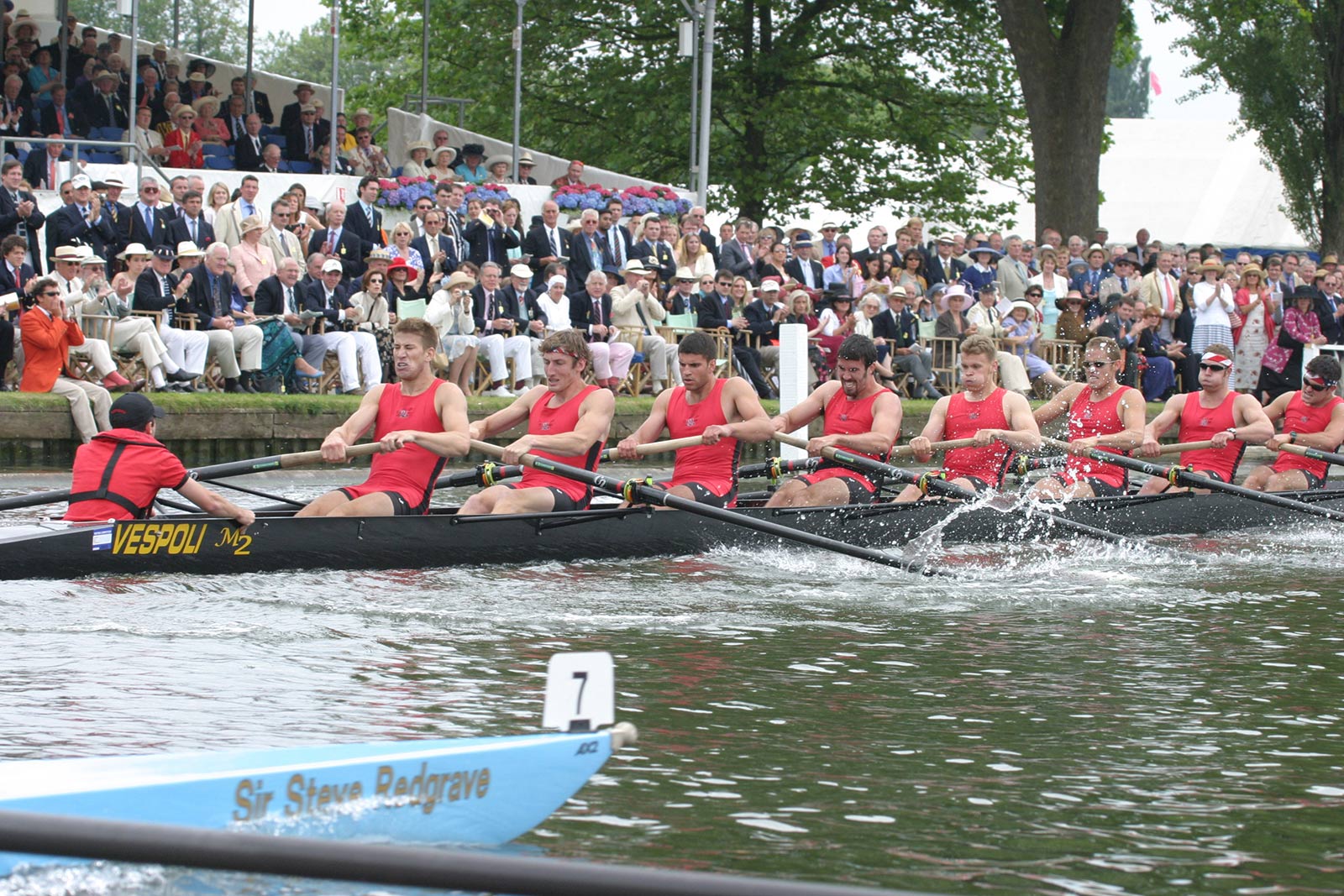
“Rowing is the ultimate team sport. Team members have to be very strong and very fit. It’s a power endurance sport. As an individual, you have to row really well, efficiently and very precisely. And then you take that individual effort and combine it with seven other guys in a boat doing the exact same thing. And it’s important when you do it, it’s not just for aesthetics, it’s to make the boat go faster. If everyone rows 100% together, the boat goes faster. If you’re ‘only’ 99% together, you’re not going to go as fast.”
Will Porter RC ‘89 was a member and captain of the Rutgers men’s rowing team and went on to the US National Team, earning a bronze medal at the World Championships and a silver at the Pan American Games. He became the freshmen coach at Rutgers before his current role as the head women’s rowing coach at Yale, leading his Varsity 8’s to win four NCAA Championships. His first exposure to rowing was during his time at Phillips Exeter Academy, a prep school in New Hampshire. “In contrast, most of the other Rutgers team members were walk-ons who had little to no experience in the sport,” recalled Porter. “It’s a heavy time commitment to be a team member, between the hours of training and keeping up with school work. It takes a strong work ethic and commitment to something bigger than yourself to achieve success in rowing.”
Porter cited the camaraderie and lifelong friendships he made with Rutgers team members as the memories of his times on the Banks, along with periodic attempts to remove the letter B from the signage outside Brower Commons (dining hall) to temporarily name it the Rower Commons in honor of the team. “Overall, the hard work we put in paid off in our success on the water and in life. While the start times of practices are early in the morning and it was often a challenge to get to the practice facility, in the end, there is nothing like the feeling of being out on the water to start your day and work with your teammates.”
As a club sport, (Men’s Crew was a varsity sport before 2007) the team is supported solely through the Friends of Rutgers Crew alumni donations and the athletes themselves. The alumni contribute over $100,000 annually in addition to building endowments now totaling $4.2 million. The endowments cover equipment and some operating expenses including the Head Coach position, the only endowed coach at Rutgers. “We’re a no-frills team. We use vans to travel to some events to save money. And we use buses only when we have to. If we’re going to Washington, D.C. for a meet, and we have to race at 9 a.m., we’ll get on a bus at 5 a.m. and go down to do that, compared to the varsity team sports that fly or bus in the night before and stay in a hotel. The team members cover the cost of their uniforms and training gear. A new 8-oared shell costs around $65,000, and an oar can cost $350. While we have alumni who generously support our program – and come back to campus to speak with our crews – we need more support to lessen the financial burden on our athletes while they represent Rutgers on the water, and prepare for their classes and post-school career plans.”
To make a donation to support the Rutgers men’s rowing team, visit Men’s Crew Fund | Rutgers University Foundation