- 848.932.7474
- info@rutgersalumni.org
For Livingston students in the 1970s, jazz was a part of everyday life – the way it was for jazz department founder Larry Ridley growing up in Indianapolis. Former students and faculty share their stories.
by Steve Zurier LC ’77
Nothing comes out of thin air.
In the book The Talent Code, author Daniel Coyle makes the case that hotbeds of talent are nurtured by dedicated teachers and coaches, whether it’s the Argentinians in soccer, the Americans in competitive swimming, or the Russians in tennis.
Same holds true for jazz.
Larry Ridley, founder of the Livingston College Jazz Department, which was later integrated into the Mason Gross School of the Arts and became one of the country’s elite jazz programs, often points to his upbringing in Indianapolis. In a November 4, 1979, interview, Ridley told WBGO-FM radio’s Ed Berger that Indianapolis was a Midwestern crossroads for many of the black bands that toured the country in the 1930s and 1940s.
On any given night, the likes of tenor men Dexter Gordon and Wardell Gray and bassist Ray Brown would play gigs along Indiana Avenue in Indianapolis, where there were more than 30 jazz clubs in the heart of the black community. Other jazz greats such as Duke Ellington, Ella Fitzgerald, and Nat King Cole were frequent headliners along what became known as “The Avenue.”
“We had fantastic jam sessions,” Ridley told Berger. “And with the Montgomery brothers, Wes, Buddy, and Monk, we had a family orientation.”
Music and spirituality were all around Ridley in those days, both at home, in the African Methodist Episcopal Church where he became an altar boy at 7-years-old, and the broader community. In an interview with Open Sky Jazz posted on November 12, 2018, Ridley said he started playing the violin when he was five-years-old. His family was very much involved with jazz. Ridley’s uncle, Ben Holloman, was a good friend of pianist Eubie Blake, and Holloman was also friends with Hoagy Carmichael, who wrote Stardust in 1927.
Later, he started playing with a cadre of Indianapolis musicians that included trumpet masters Freddie Hubbard and Virgil Jones, and pianist and Hammond B3 organist Mel Rhyne. They all started playing together as teenagers and Ridley’s first group was called the Jazz Contemporaries.
Here’s the lineup: Hubbard played trumpet, James Spaulding, who later came to study and teach at Livingston College, played alto and tenor saxes and flute, and Paul Parker was the drummer, along with Walt Miller and then Al Plank on piano.
Once Ridley’s reputation grew, he was asked by fellow Indianapolis musician, trombonist Slide Hampton, to play bass in Hampton’s band, and he even subbed for bassist Monk Montgomery when Monk was away on business on the West Coast. So it just makes total sense that Ridley and fellow Livingston professors Spaulding, and guitarist Ted Dunbar, who moved from Texas to Indianapolis to be closer to Wes Montgomery and wound up subbing for the famed guitarist, played on some of the most seminal jazz recordings of all-time.
Here’s a sampling: Ridley played on Horace Silver’s The Jody Grind and was on Lee Morgan’s Cornbread; Spaulding played flute on the epic spiritual recording by Pharaoh Sanders: The Creator Has a Master Plan, and Spaulding’s flute graced Freddie Hubbard’s famous jazz standard, Little Sunflower; to get a good idea how Livingston profs Ridley, pianist Kenny Barron, and drummer Freddie Waits became an in-demand rhythm section, check out the recording by saxophonist James Moody entitled Feelin’ It Together.
When it comes to recordings and performances, it’s a long list, but it’s also important to note that Ridley and saxophonist and Livingston jazz professor Paul Jeffrey were among the musicians who played the final tours with the legendary pianist and High Priest of Be-Bop, Thelonius Monk. Here’s a link to a picture of Ridley and Jeffrey with Monk in Tokyo during a 1970 tour.
The seeds of the Livingston jazz program were planted in Indiana
Ridley told WBGO’s Ed Berger that he got the idea for a jazz program back in the mid-1950s when he was a student at Indiana University with David Baker, who was also from Indianapolis and later became a prominent jazz educator who pioneered jazz education by writing Jazz Pedagogy for Teachers and Students.
“I always regarded jazz as African-American classical music and saw how the Dean [at Indiana University) brought all these fantastic European classical musicians on to the faculty who would go off and play and then come back to teach. I thought there needed to be the same kind of thing for jazz,” Ridley told Berger.
Fast forward to the early 1970s when Ridley was finishing up his degree in music education at New York University. Ridley told Berger he was looking for a way to teach and Lloyd McNeill, a visual artist and a working jazz flutist who was one of the first music department faculty members at Livingston, helped arrange an interview with Dan Newman, then chair of the music department and Ernest Lynton, the first Dean of Livingston College.
Remember the times: the late-1960s, early 1970s. Early plans for Livingston envisioned a college that would be small, multi-racial, and innovative in its course offerings. In light of urban rebellions in Newark and other cities, Livingston was charged with addressing contemporary problems through teaching, research fieldwork, and internships. The college was also expected to bring more minority students and faculty into Rutgers.
So when Ridley met with Dean Lynton and Newman, at least the two of them were receptive to what Ridley wanted to accomplish. However, Ridley told Livingston MEDIUM founder Jim Simon LC 74 in a 1977 Associated Press interview that there was some skepticism among the Rutgers brass. “We had a lot of trouble convincing Rutgers that jazz was a legitimate area,” Ridley told Simon. “We had to impress academic music people that Western European classical music is not the only viable area for study. Not everybody wants to join a symphony orchestra.”
Ridley, who went on to become one of the leading advocates for jazz and jazz education clearly won them over: “I came in with a no-nonsense approach, and told them I wanted the students to learn from people who were working musicians in the field,” Ridley told WBGO’s Berger. “I wanted the students to rub shoulders with the professionals. A lot of this you can’t put on paper. You have to become a part of it to know what it’s all about. You have to see what it feels like.”
When Ridley was hired in 1971 as an assistant professor, there were only 15 jazz degree programs in the country, a number that jumped to 72 about 10 years later, and today stands at more than 120, according to Jazz in America. The first official bachelor’s degree program in jazz was founded in 1947 at North Texas University in Denton, Texas. By the 1960s, jazz degree programs were offered at Indiana University, the University of Pittsburgh, and the Berklee College of Music, though jazz was always a focus ever since Berklee’s founding in 1945.
During Ridley’s first year at Livingston, the music department included chairman Newman; Daniel Goode, a clarinetist who served as director of the electronic music studio; McNeill, a working musician and artist who studied with Pablo Picasso in Paris; composer, Philip Corner; pianist Brian Dallow; and Barbara Benary, who ran the Gamelon ensemble.
The jazz program was formalized in 1972: Dunbar and saxophonist Frank Foster (composer of Shiny Stockings) were hired in 1972, Barron was hired in 1973, and Spaulding, Harewood, Waits, Jeffrey, and trumpeter Bill Fielder were added to the jazz faculty in the mid-to-late 1970s and early 1980s. Along with serving as drum set instructors, both Harewood and Waits taught African drumming and polyrhythms, which was very innovative for a university setting at the time.
According to the 1972-1973 Livingston College Course Catalog, students were required to take 10 courses in the music program. The courses included studies in music making, composition, and theory courses that focused on both Western and non-Western musical traditions. Students were exposed to folk, popular, and experimental music, as well as “traditionally acknowledged classics.”
Kenny Barron describes the early days as a bit of a struggle. “There were some tough auditions,” said Barron. “I remember one student who looked at an audition piece that had some sharps in it and looked up and said, ‘I’m not really in to sharps.’ And with another student, when I asked him to name some of his favorite jazz musicians he said: ‘I don’t really listen to jazz.’ I was stunned, then wondering why he was there in the first place? I thought maybe he thought it would be an easy way to get a degree. Needless to say, that audition didn’t last very long.”
But word got out, especially about the talented jazz professors. There were frequent faculty concerts at Lucy Stone Hall, and while precious few recordings have survived, Barron pointed out a duo concert he did in February 1975 with Ted Dunbar that was recorded live as In Tandem and listeners can hear it on YouTube.
The seeds were sown and all the hard work began to pay off. Talented students who wound up having long careers in jazz and the broader music industry began to make their way to Livingston. One was vibraphonist Steve Nelson (LC 77) from Pittsburgh. In a July 17, 2024, JazzTimes interview with John Murph, Nelson said he was introduced to the vibes by a good friend’s father, George A. Monroe, a steelworker by day, but also a talented vibes player in the Milt Jackson tradition. Monroe also taught Nelson some piano basics.
“He taught me in a very hands-on type of way—like, ‘Put this finger here, then put this finger there – now play that chord,’” Nelson told Murph. “That’s the kind of learning you cannot get in a classroom with 50 keyboards and a teacher in front of you. I learned from all the older cats in Pittsburgh. I had wonderful Sundays of learning tunes, substitute chords and a whole lot more before I’d ever set foot in a music school. By the time I started college, I was already playing pretty well.”
Another one was guitarist George Naha LC 76, who had a very diverse career in music, touring with singer-songwriter Steve Forbert for five years and backing up the Queen of Soul herself, Aretha Franklin. Naha said he’s forever grateful for the opportunity to study and play with all the talented jazz students and faculty at Livingston. “Here I am, this 20-year-old kid who’s just getting in to try and play this music, and I’m in a band with Steve Nelson and James Spaulding? How did that happen?” said Naha. “And I knew that they were lightyears ahead of me, and I had to not let that bother me after a while and just say” ‘they’re where they are, I’m where I am, I’m going to stay within myself and just play the best I can, and contribute something worthwhile to this music.’”
Still another talented student who was around Livingston in the early 1970s was singer-songwriter Deborah Holland (Heilner), who formed Animal Logic with bass legend Stanley Clarke and ex-Police drummer Stewart Copeland. Holland also has fond memories of her Livingston years. “It was a little family, very artsy,” said Holland. “Teachers came in with their dogs, some students slept in practice rooms. I was able to dabble in everything: Moog synthesizers, gamelans, you name it. It was a very eclectic program and was a great fit for me.”
Holland also struck up a strong relationship with Kenny Barron. “So the first class I had with Kenny was keyboard harmony,” said Holland. “Without getting into too much musical detail he would give an assignment and I would end up using what I had learned in my songwriting. I also had him as a private piano teacher and at some point he asked me to bring in my songs. One day I brought in my guitar and sang him two or three and he said, ‘You are a bad MF,’ which was the highest compliment one could receive. Kenny assembled the jazz faculty and we recorded three songs. I don’t even think I was THAT good then. but his affirmation of my talent was life-changing.”
Tenor sax man Jerry Weldon (LC 81) has become a stalwart on the NY/NJ jazz scene for the past 40+ years, playing in both Lionel Hampton’s and Harry Connick, Jr.’s bands. Weldon also stayed close to his be-bop roots, playing in organ trios with Jack McDuff, Jimmy McGriff, and many others.
Weldon credits saxophonist Paul Jeffrey for bringing him to Livingston College. After doing a stint at a community college and about one year at Indiana University from the spring of 1977 to 1978, Weldon went back to New York to start working. “Truthfully, I didn’t know what I was going to do, I thought I might join the Army band,” said Weldon, in a recent video interview.
Once back in New York, Weldon started taking lessons with Jeffrey and later in 1978 Jeffrey told Weldon that he was hired as a professor at Livingston College. Jeffrey, with help from Larry Ridley, secured some scholarship money and Weldon found a home at Livingston.
As a student, Weldon said he became Jeffrey’s “right hand man,” working closely with Jeffrey to write charts for many of the special programs the students would do with the likes of drummer Philly Joe Jones, who once brought Dameronia to the college, a band that paid tribute to composer and band leader Tadd Dameron. Weldon also formed a close friendship with Thomas Chapin, a saxophonist and flutist who before he died tragically of leukemia in 1998, became one of the pioneers in the avant-garde scene at the Knitting Factory in New York City in the 1980s. Weldon said Chapin was also such a good straight-ahead jazz player that immediately upon graduation in 1980 he was hired by Lionel Hampton – and that’s how Weldon got the job with the Hampton band.
“When I came out, Thomas got me in the band, and there was also Dave Schumacher, the great baritone sax player, he joined the band, Adam Brenner [on alto sax], and for a while we had an all-Rutgers section in Lionel Hampton’s band,” said Weldon. “That says something about where we came from musically.”
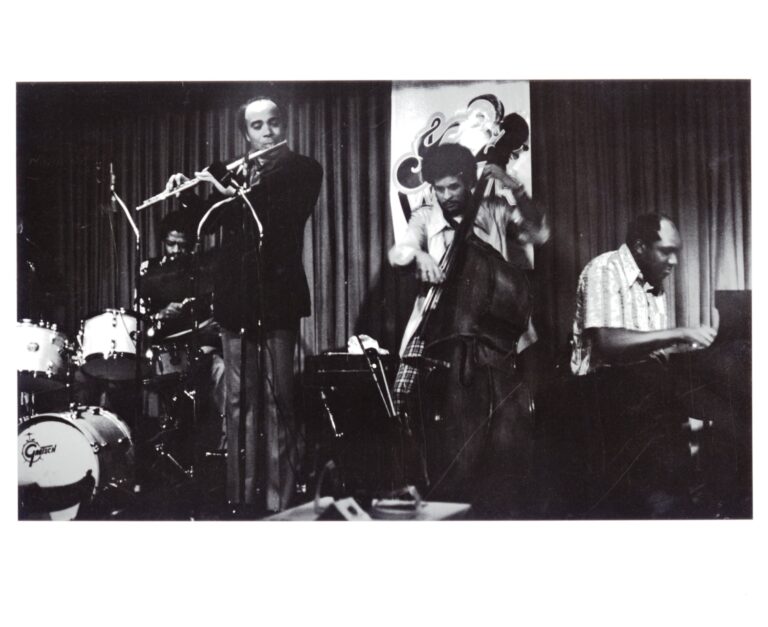
Bassist Mark Helias LC 74, a Livingston College Distinguished Alumni honoree, is a longtime stalwart in the avant-garde jazz scene in New York. Helias said what he appreciated about Livingston was the variety of musical information that was available. For Helias, Livingston College was a portal for access to the other divisions of Rutgers. He played in the University Orchestra and took courses in ear training, theory, and music theory at the other campuses. “There was a lot of good energy there, and I most certainly benefited from my work with the improvisers who taught [at Livingston], they were universally generous people,” said Helias.
One time, Helias said the guest artist was bassist Richard Davis (seen here playing a duo with Ted Dunbar), who brought a band to play at Lucy Stone Hall. The lineup was Davis on bass, Marvin Peterson, trumpet, Billy Harper, tenor sax, Stanley Cowell, piano, and Freddie Waits on drums. “The band was phenomenal and to hear them in an intimate setting at the school was a joy,” said Helias. “The thing that really shook me in a good way was to see how Richard Davis led the band from the bass in such a powerful and authoritative manner while allowing everyone to stretch out and play. It was a joyful experience and has stuck with me all of these years.”
The jazz wasn’t just for music majors
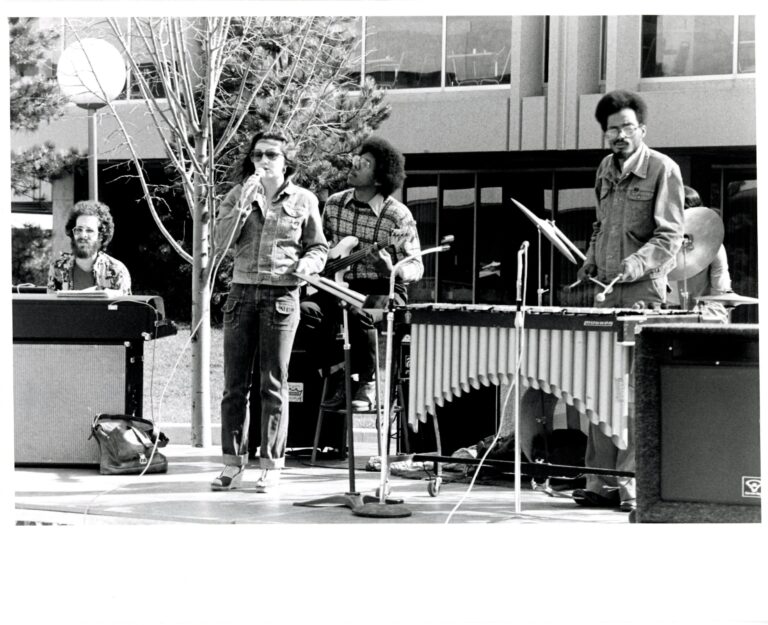
Non-music majors also have strong memories of the jazz scene at Livingston College. Rob Snyder LC 77, Professor Emeritus of American Studies at Rutgers-Newark, said he arrived at Livingston College in 1973 as a confirmed “folkie” with a strong taste for rock music, but also an interest in jazz. Snyder remembers how faculty members would play at weekly sessions on the Plaza outside Tillet and Lucy Stone Halls on nice days in the spring and fall, and they played indoors when the weather got colder. “Just by going to school at Livingston and being on the campus, I got an education in jazz,” said Snyder. “It was almost as if it happened by osmosis. You didn’t have to go to any courses. You didn’t have to read any books on the subject. You just heard it, and you developed an educated ear because of that.”
Many years later, sometime around 2010, Snyder said he ran into Ridley in New York City. He introduced himself as a Livingston graduate, and told him how much he loved the jazz scene at Livingston. “And I stressed that one of the things I liked about it was that it didn’t put jazz up on a pedestal,” said Snyder. “It was part of everyday life.
“And I was fascinated when Larry responded to me and said that was his goal. Jazz was part of everyday life when he was growing up in Indianapolis. He talked about the African-American neighborhood that he grew up in Indianapolis, and how you could hear jazz everywhere. He wanted to make jazz central to the life of Livingston College. He succeeded in that, and he not only succeeded, but he taught a lot of people. He taught some people to be great players, and he taught far more people like me to enjoy and value jazz, and I have ever since. So I’m very grateful to him for that.”
Other students we reached out to had similar comments about the Livingston jazz program. Lynette Rock (LC 78), who entered Livingston in 1973 and graduated in 1978, said the amazing jazz faculty was a highlight for her. “I grew up in a home where my father had an extensive jazz collection and music was always in the air,” said Rock. “The musicians at Livingston were a pleasant surprise for me: Spaulding, Larry Ridley, Michael Ridley, Steve Nelson, and Kenny Barron just to name a few that I got to know.”
Rock said she took a flute class with Spaulding and a jazz class with Larry Ridley where the students studied the famous modal piece “So What” by Miles Davis. “I’m sure I attended every concert in Lucy Stone, outside Tillet Hall, and in the Livingston Pub,” said Rock. “I even got to experience singer Jeanie Bryson as a student. It was a great time.” Editor’s Note: Bryson, a 2018 Livingston Distinguished Alumni, sadly passed away from cancer this past summer.
Jerry Livinsky, a 1978 Livingston graduate who double-majored in philosophy and labor studies, remembers the jazz program well. “I’ve been an amateur musician with a passion for jazz my entire life,” said Levinsky. “I even had the mind-blowing experience of taking a few piano lessons with Kenny Barron and of course vividly remember the impromptu concerts outside of Tillet and Lucy Stone Hall.”
Mike Guta (LC 78) was a political science major who also had a keen interest in fingerpicking blues and was quite adept at playing ragtime and old blues numbers on his acoustic guitar. And while jazz was not his main musical interest, Guta says he was always quite impressed with the way the jazz professors carried themselves. He even wrote a song about the Livingston jazz profs:
“The life they have led,
Gives them the added edge.
The feelings they have felt,
They couldn’t keep in,
They bleed them.
They play as they work,
And work as they play,
The sage.”
“The ‘life lessons’ they gave us was that to do anything well, you had to find the beauty in what you were doing,” said Guta, also a former Livingston MEDIUM Editor. “That was something my father said to me many times, and while watching the jazz players dive into the music at Livingston, I finally saw what he meant. I cherish those memories, especially since my Dad passed away my sophomore year at Livingston.”
After graduating Livingston in 1978, Guta spent three years in Iowa working as a Vista volunteer. Then after graduating Rutgers Camden Law School, he headed out to San Francisco where he was admitted to the state bar in California in 1985. True to form, Guta also struck up a friendship with future Smalls Jazz Club founder Mitch Borden, who also plays the violin. The duo played some gigs around San Francisco and recorded in Guta’s apartment during those years.
After Borden opened up Smalls in Greenwich Village in the early 1990s, Guta said Borden would often say that Mike “was the second guy” whoever stepped into the club. Smalls became a New York institution. On any given night, Borden would happily sit on a stool at the front of the club and collect everyone’s $10 entrance fee. In those early days, that $10 bought nearly 10 hours of music – and the music would go long into the night, until the next morning. Guta says Borden is still at it, running Ornithology Jazz Club in Brooklyn – and still can play Charlie Parker be-bop lines on his violin.
A few years ago, Guta saw Kenny Barron play in San Francisco and after the gig, struck up a conversation with the pianist. “It had been 50 years since I saw him first play at the Livingston Pub,” says Guta. “After he performed I went up to him and we chatted for a while. We never actually met before because I never had formal music lessons and didn’t take any courses in the jazz department. He looked as regal as always. We had a nice talk, and I thanked him for the ‘life lessons’ he helped teach me outside of class that I carried for 50+ years.”
And, although it didn’t always feel like we were respected across the river back in the 1970s, there were Rutgers College students who were attracted to the high level of jazz at Livingston.
“I was there from 1978-1982 and what was going on at Livingston was good enough that I, as a liberal arts student on the other side of the river on Main Campus knew – despite the fact that we had Greasy Tony’s over on Easton Ave. – the best thing going was the jazz over at Livingston,” said Jonathan C. Hyman (RC 82) in a recent Facebook post initiated by Rob Snyder.
“The people teaching were great players,” said Hyman, who told 1766 Magazine that he spent a lot of time studying and playing jazz in high school, but opted to pursue a career as an art photographer. “And they performed. The student ensemble was filled with fine, already-working players. And they performed. And the special guest musicians were real, live jazz cats.”
Sal Caputo LC 75, a former MEDIUM arts editor who had a long career as a music journalist at the Arizona Republic, studied electronic and avant-garde music with Daniel Goode and others during his Livingston years. He had a good story about when famed pianist Teddy Wilson came to Livingston.
While Wilson arguably is best known for his partnership with the Benny Goodman Quartet in the 1930s that also included drummer Gene Krupa and vibraphonist Lionel Hampton, Caputo retold a hilarious story about a gig Wilson was on with Louis Armstrong in Kansas City that must have been pre-1937, before marijuana was illegal. Evidently the promoter’s task of taking care of the band has a long history, and as Caputo related Wilson’s story, for this night in Kansas City, the staff lined up marijuana joints on the music stands of the working musicians. The biggest one was for Armstrong himself, who was given a giant joint that looked like a big cigar. “At the time it wasn’t illegal, and the guy was just opening up about this thing,” said Caputo in a recent video interview.
And when Yusef Lateef came to Livingston during his freshman year in 1970-1971, Caputo said Lateef shared a great anecdote about John Coltrane’s dedication to his craft: “I think the way it went was that he had to pick up Coltrane to take him to a gig that they both were playing. As he walked up to Coltrane’s doorway, he could hear John playing. He was welcomed in and then Coltrane showed him all these colored charts he made about harmonic relationships and scales and demonstrated some of those things for him on the sax. I think that Coltrane told him that he had been practicing his horn since he got up, and now they were heading for a club gig in the evening. They played your standard evening – several sets, probably until midnight – so John has been playing most of the day, except when Yusef is driving him to the gig.”
“When the main gig is done, they go play an after-hours jam until early morning. Yusef then drives him home and lets Coltrane out. Yusef had gone some distance from Coltrane’s when he realized that John had left something in his car, so he drives back to Coltrane’s place, carries whatever it was with him, figuring John would be relieved to get it back even if he had to wake him up to give it back to him. As Yusef walks up the hall, he hears Coltrane playing: That’s almost 24 hours of playing, Lateef noted, and as he’s telling us this you could see audience members’ eyes widening. Yusef said something like, ‘That’s the kind of dedication he had.’ All I can say all these years later is that I may not tell the story as Yusef actually told it, but it made enough of an impression on me that I’ve carried my mutilated version of it through about 55 years and had to retell it because I was so dumbfounded by this intimate look at Coltrane’s stamina, perseverance, and creativity.”
Valuable lessons from the many guest jazz artists
Everyone we talked to remembers the special concerts where Ridley took advantage of all his contacts in the New York jazz scene to bring them down to Livingston to work with the students and play special concerts.
George Naha remembers a night where Sonny Rollins came to Livingston.
“I think every sax player within 50 miles showed up for this one, Richie Cole was there, Spaulding,” said Naha in a recent video interview.
Naha said Rollins put on a great show and the night ended with the famous calypso piece by Rollins, St. Thomas. All the saxophonists lined up to take a solo, but Naha said the one he remembers best was the solo by Spaulding:
“So it comes to James’s turn, and he starts off playing super simple melodies, playing St. Thomas as a folk song, then he starts to run solos off just those simple triads. Then he starts running some more stuff and every time around it gets a little more complicated and he’s drawing more elements of the playing, then it’s starts to break out a little bit free and break away from the chords and in the middle of it – all of a sudden this big joyful ‘shriek’ comes out of his alto. It was like a comet shot out of the bell of his horn straight up and went right through the ceiling in Lucy Stone Hall. He held this big joyful shriek for the longest time, it was like: Wow, did you see what he just did? Unbelievable what he did that day.”
Steve Zackim, a pianist who spent many years playing on cruise ships based in the UK and is now writing a score for a new musical, remembers when Ridley brought pianist Teddy Wilson and famed Mahavishnu Orchestra drummer Billy Cobham to campus to play a trio concert.
“I remember I was down the hall and heard these incredible loud drums that were playing amazing things and I walked into my class expecting to see the class and it was Billy Cobham,”said Zackim in a recent video interview. “That kind of experience you can’t put a price tag on. You’ve been told, ‘don’t play jazz because you’re going to wind up a pauper.’ But my love of jazz didn’t make me a pauper. I earned a decent living, and became rich in spirit .My love of jazz gave originality, timelessness, and freshness to everything I composed. And at 72, I still see the infinite possibilities that jazz has given me to still compose music that is fresh and original.”
Damon Foreman (RC 77), who wound up running Damon Foreman Music Academy, a music school in Glenwood, Md., was a Rutgers College chemical engineering student who by dint of the university’s open policy took a boatload of jazz courses at Livingston.
Throughout his time at Rutgers, Foreman took four years of jazz improvisation courses with Ted Dunbar, whom he describes as a major influence in his life, a jazz ensemble with Frank Foster, and theory courses as well as music history, including jazz history.
Foreman said Livingston had a great atmosphere. He explained in a recent video that one day out of the blue famed Return to Forever pianist Chick Corea sat down at his lunch table and told him he was on campus to play a concert and work with the students. Foreman was stunned, saying it was an example of how humble the jazz people were, both the professors and the visiting guests.
Another visitor who offered some advice that stuck with Foreman for many years was vibraphonist, Milt Jackson, most famous for his long relationship with the Modern Jazz Quartet. Speaking to the music students at Livingston back then, Foreman said Jackson didn’t mince words:
“It’s a tough world financially if you want to pursue music,” Jackson told the group. “If you can do anything else – do it – but if you’ve got to do music, then you got to do music.” It was an admonition Foreman took seriously because upon graduation, he pursued a career as a chemical engineer. While he wound up in tech sales, by around 1998, Foreman said the company he worked for did a lot of business with Worldcom and when the large telecom collapsed, his company ultimately lost much of its sales. The company offered him a job in the Chicago area, but Foreman had two young kids in Maryland schools and decided he had enough of the corporate world. From then on, he pursued music full-time and by 2007 opened up the music school.
Hyman, the Rutgers College student who frequented the jazz concerts and special sessions at Livingston, said his two fondest memories are when he attended a workshop with the tenor sax master Frank Foster, who discussed how he came to learn and finally play John Coltrane’s seminal Giant Steps.
Another great memory was how Hyman ended up backstage, alone, sitting with all-time sax legend, Sonny Stitt – after having been sent to tell him it was time to come out and perform.
“I said, ‘Mr. Stitt, your audience awaits and then he said, ‘That’s nice, really nice. Get me a glass of water and sit down.’” Stitt then asked, “What brings you to the event tonight?” Hyman said, “I am a fan of your playing, know your music, and play the sax myself, though I can’t improvise well enough to play what I hear in my head.” He said, “That’s nice, really nice. You’ll get there.”
Hyman said he then sat together in silence with Stitt for at least a full minute until Sonny stood up with the assistance of my arm and said: “Thanks, time to go kill ‘em.”
So clearly, all this great music at Livingston College and for decades at the Mason Gross School of the Arts, didn’t come out of thin air. It had its genesis on “The Avenue” in Indianapolis, where a young Larry Ridley learned the ropes from the many jazz greats he crossed paths with while growing up in Indiana.
As saxman Weldon put, it all exploded very quickly at Rutgers. By the 1980s, Rutgers attracted strong players such as Terrence Blanchard, Terrell Stafford, Harry Pickens, and Ralph Bowen to the program, and even had a student hit the pop charts when Regina Belle (Rutgers 2015) recorded A Whole New World with Peabo Bryson in Disney’s Aladdin in the 1990s.
For Al Howard, a longtime professor of West African History who passed away in July 2025, jazz was one of the real positive forces around Livingston College. In an May 2010 oral history interview, Howard recalls the importance of jazz at Livingston:
“Another thing that drew a lot of people on [campus] were the jazz concerts, and jazz was a very important part of Livingston College from early on, and several well-known jazz artists were hired and stayed for years and years. Larry Ridley was a major figure, and I still see him every once in a while. Another very important person was Lloyd McNeill, who also made a lot of records, but was also a painter and his painting would be up. So these were people who were full-time members of the faculty and really contributed a lot to faculty discussions. When they would perform…they would draw a lot of people.”
And those “Bright Moments” live on in all of these shared memories. We live in a time of great disrepair. Where the haters are amplified on endless streams of podcasts, social media posts, and AI-generated misinformation. Who can believe anything they read or see in the news or online anymore?
So even for a brief moment, think back to a time before the internet, before Facebook and Snapchat and “AI-enabled” videos – and appreciate the long-lasting impact the Livingston Jazz Department had on so many lives.
Not everybody got it. All the different subgroups had their own music and special concerts and guest artists on campus. The Ohio Players were often more popular than jazz – and rock was still going strong and concerts by the likes of Hot Tuna and the New Riders of the Purple Sage drew huge crowds.
But I still like to believe that the Creator does have a master plan – and part of it was bringing us all together for those years at Livingston College.
It’s a lot to unpack – revisiting those Livingston years. And for certain, it’s much more than that 7-year-old alter boy in Indianapolis in the 1940s could have ever imagined.
Steve Zurier (LC 77), was a history major and former editor of the Livingston MEDIUM. Steve is still active in the tech press and moonlights as an upright bassist in jazz and klezmer bands in the Baltimore/DC area. Zurier remains ever grateful to the Livingston College Jazz Department for the lifelong gift of jazz.