- 848.932.7474
- info@rutgersalumni.org

Note: Ed Barocas passed away on September 11, 2026, losing his valiant fight against muscular dystrophy. This article was written and posted prior to Barocas’ passing.
By Marty Siederer LC ’77
For many people, a memoir is a look backward. For Ed Barocas RC ‘89, it is also a look forward and a testament to the power of perseverance, personal growth, and the enduring pursuit of justice. Barocas was born with muscular dystrophy and has used a wheelchair since he was 32 years old. In his recently published memoir, Chasing Justice and Butterflies: A Memoir of Overcoming and Becoming, Barocas invites readers on a deeply personal journey marked by challenge, transformation, and self-discovery. Barocas reflects on the experiences that shaped his life while offering readers a compelling message about resilience and the human capacity to evolve.
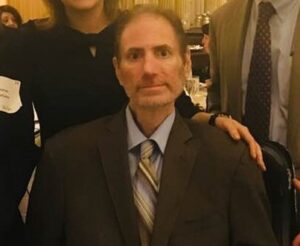
Barocas’ Rutgers journey began in 1985 as a philosophy major living at Hardenburg Hall on the College Avenue Campus, with his housing in later years including a dorm room at Brett Hall. Barocas was a member of the Alpha Epsilon Phi fraternity, and his campus memories include performing with the Scarlet Gnats improv comedy troupe, traveling with dorm mates to Philly in a snow storm to watch the men’s basketball team defeat Temple before winning the conference title days later by beating Penn State at the RAC, going to the Grease Trucks on numerous late nights, and visiting his older sister (DC ’86) at her apartment above the Skinny Vinnies pizzeria shop on Sicard Avenue in New Brunswick. After graduating from Rutgers, Barocas earned his law degree from George Washington University. His path to a legal career was inspired by two childhood heroes: Curious George and Horton the Elephant from Horton Hears A Who.
According to Barocas, “Curious George was always getting into trouble, just by being himself. But in the end, George not only created joy for himself, but for others as well, simply by acting on his natural inclinations and making sure to live literally ‘outside the box’. I thought it was important that everyone has the right to live their true nature or live outside the norm. Horton’s huge elephant ears were able to hear the people of Whoville, who lived on a speck of dust. The Whos deserved to be protected because ‘a person’s a person, no matter how small.’ That empathic elephant was the heroic role model image that I carried throughout my life.”
Barocas made the decision to focus on constitutional law during his studies at George Washington University. “The driving force in going to law school was never money. It has always been that drive to do what is right and what makes people’s lives better. I always felt we spend so much time at our jobs and you’re truly lucky and blessed if doing so and being able to make a difference is a joy,” Barocas said.
After graduating from GWU, Barocas worked with the New Jersey Office of the Public Defender, and in 2001 joined the American Civil Liberties Union’s New Jersey office as their legal director. Barocas, who now uses a ventilator, retired at 51 because of the effects of his illness on his body. He wrote the book over the past five years, dictating into his phone and then making corrections.
Barocas’ disability, as it has been in his life, is a defining aspect of the book. “Not that I dwell on it all the time. But as I go through life, there are various obstacles that I hit, so just as I’m going through the chapters, it’s natural for the disability to be a part of it,” Barocas said.
Barocas was once chided for arriving late to court. A poorly designed entryway to the Morris County Courthouse building caused him to wait outside in the snow for half an hour for a police officer to help him into the building. “I made it to court late and was yelled at by the judge. He said, ‘You better have a good reason why you’re late,’” Barocas recalled. “So, I explained to the judge what happened, and his face went from angry to embarrassed. And he said he would take care of it.” Months later, when Barocas returned to that courthouse, he found the judge had kept the promise and there was a new accessible entrance.
This article includes quotes from aclu-nj.org and montclairlocal.news